
Medmind
Shift the Effort, Not the Responsibility
MedMind is a connected medication system that combines a smart pill dispenser with a companion app to support consistent daily care. By integrating voice interaction, physical movement, and multimodal feedback, it reduces user effort and makes medication routines clearer and more reliable.
This individual project explores the intersection of digital and physical interaction. I designed and prototyped both the interface and device, investigating how voice, light, and motion can work together to guide users through often overlooked but critical moments.
Role
Product Designer
Time
1 Month
Nov – Dec 2025
Tool
Figma
ProtoPie
Blokdots
Platforms
Mobile App
Physical Device
Overview
Medication adherence is often treated as a problem of memory, but in reality, it is shaped by fatigue, cognitive overload, and disrupted routines. For many people, especially those recovering from illness, even small daily tasks can become difficult to manage.
MedMind explores how design can support users in these moments. Instead of asking users to remember more or do more, the project focuses on reducing effort, creating a system that helps people take medication consistently through clear guidance and low-friction interactions.
Context
Medical adherence is rarely about forgetting in the simple sense. For patients managing recovery or chronic conditions, daily life is shaped by fatigue and brain fog that makes even simple tasks unreliable. The challenge is not memory, it's the cumulative weight of effort.

Betsy, 45
recovering from surgery
Experiences ongoing fatigue and cognitive fog. She understands the importance of her medication, but often forgets to take it, or becomes unsure whether she already has. She avoids anything that feels complicated and relies on low-effort solutions.
The system cannot depend on attention, memory, or motivation. It needs to work quietly in the background, without adding pressure.
Approach
The design focused on mapping three recurring pain points in the medication routine, treating them as a continuous experience rather than isolated tasks.
Remembering
Timely reminders without requiring active attention from the user.
Confirming
Clear feedback on whether a dose has been taken, eliminating uncertainty.
Refilling
Proactive refill management so the system stays reliable over time.
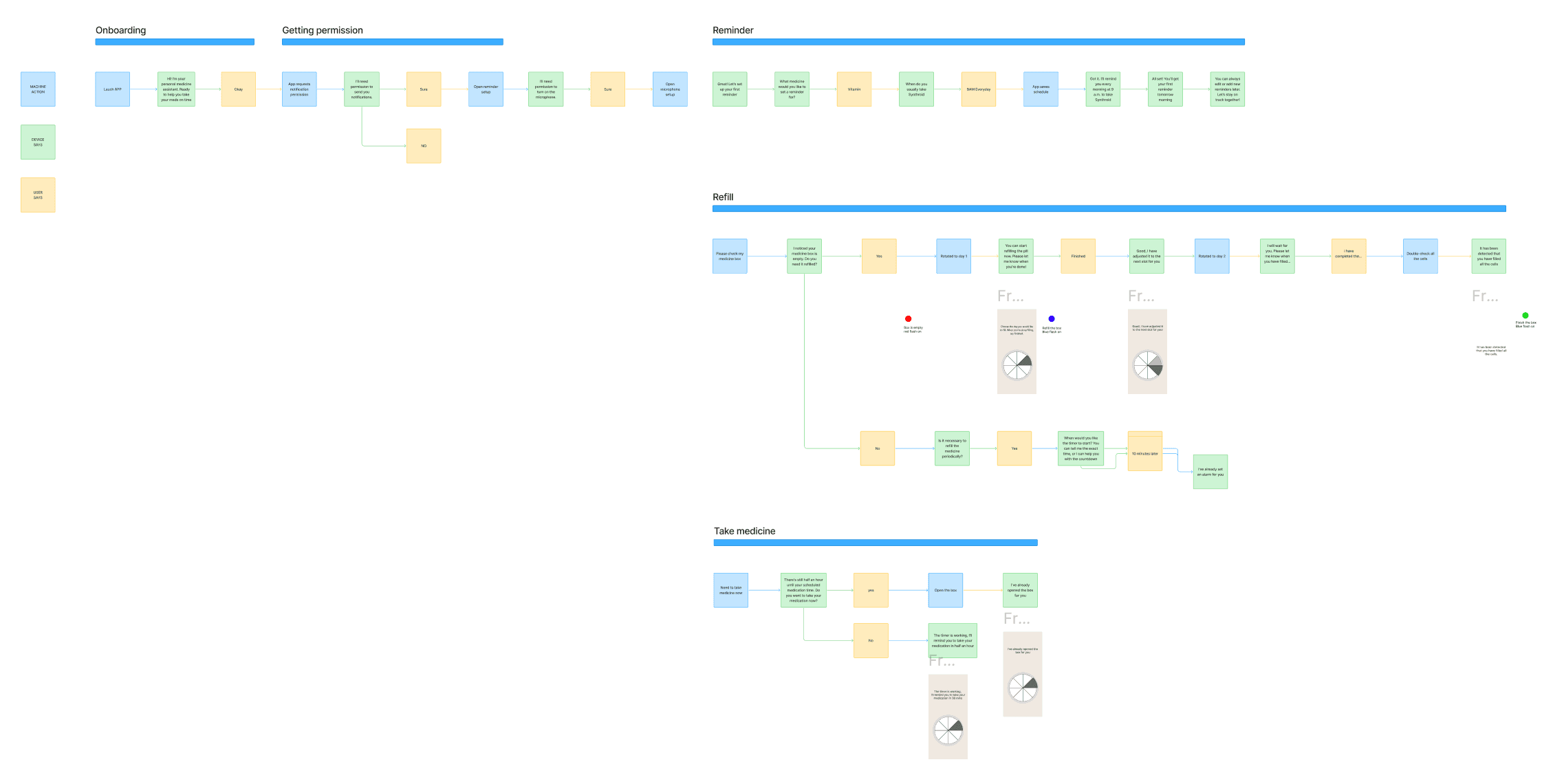
Mapping the user flow treated these as a continuous loop instead of separate tasks. By tracing each step end to end, it became possible to identify where the experience broke down: unnecessary decisions, abrupt transitions, and moments of ambiguity that could cause hesitation. Each friction point was addressed by removing redundant steps and simplifying unclear transitions, resulting in a more predictable and consistent interaction.
Design
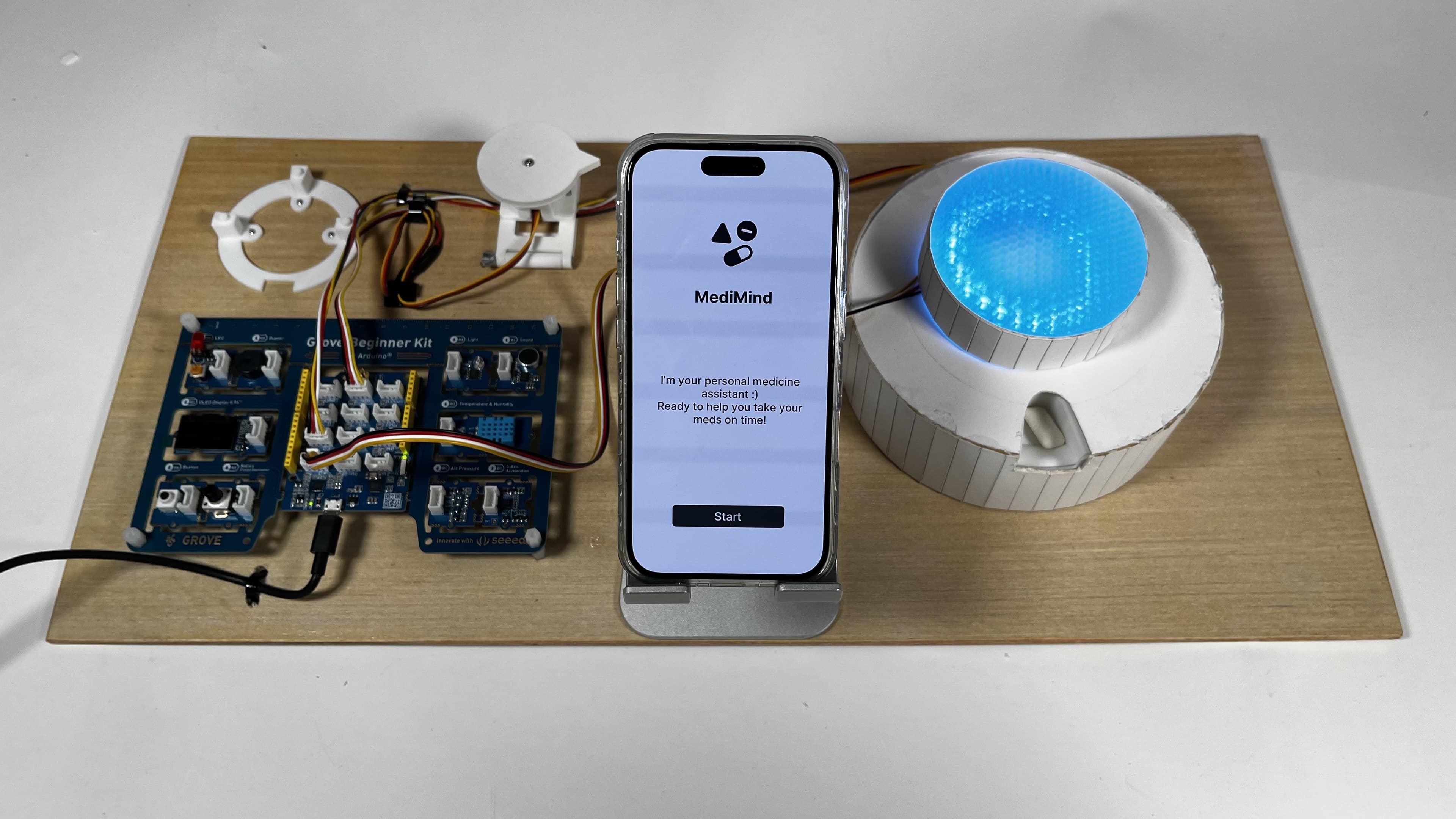
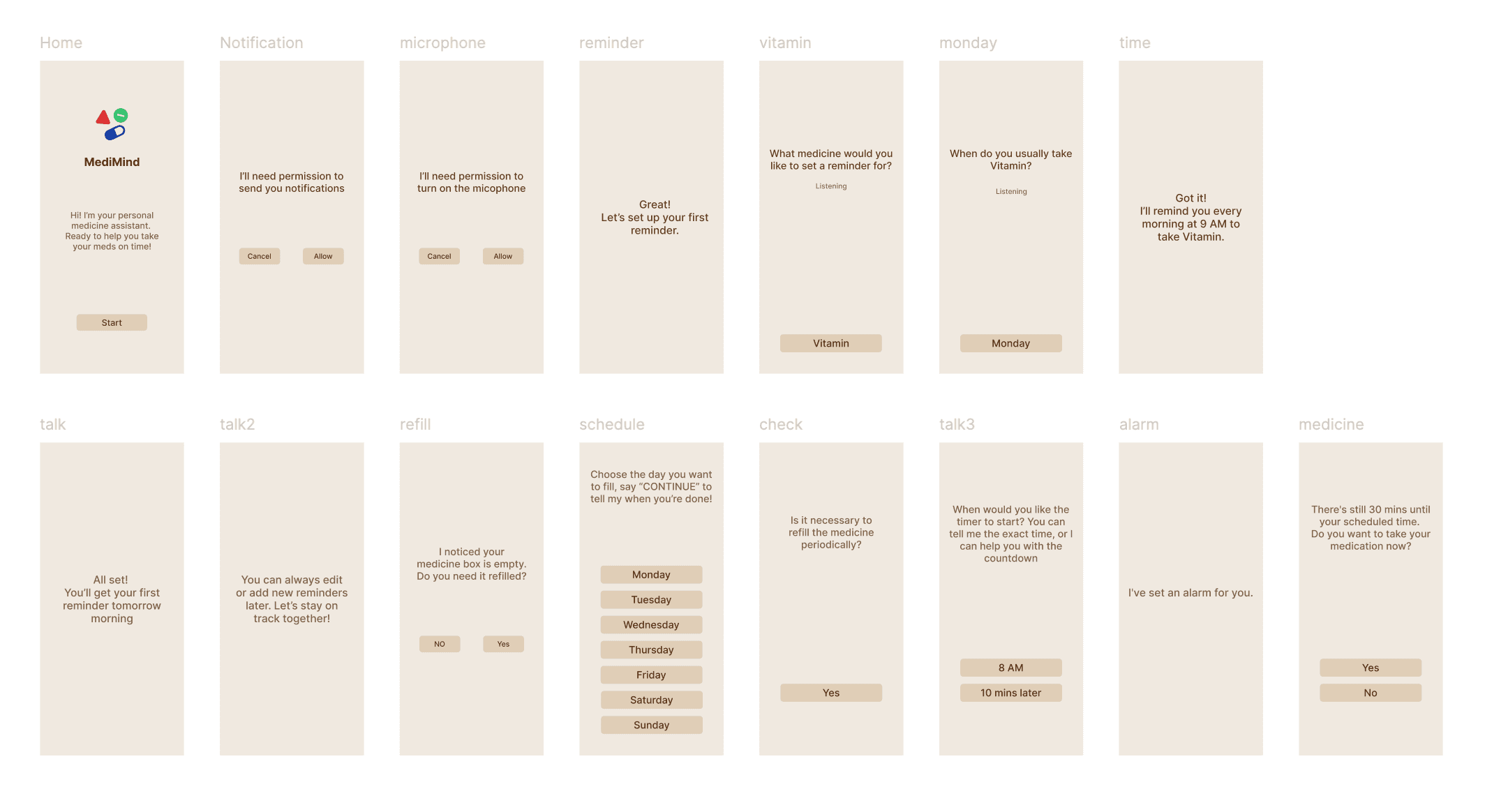
MedMind is designed as a connected system between a mobile app and a physical pill dispenser. The app delivers timely reminders and clearly communicates medication status, while the dispenser physically supports the action by rotating to the correct position.
The interaction is intentionally simple. When it is time to take medication, the system not only notifies the user but also guides them toward the correct action, reducing the need for interpretation or memory. Over time, it also supports refill management, ensuring the system remains reliable and usable.
To make the experience more accessible, the system uses multiple forms of feedback, including visual cues, sound, and physical movement. These signals work together to reinforce each action, making the interaction clearer and more dependable, especially for users with limited attention or energy.
Voice interaction was explored as an additional layer to reduce effort. Instead of creating a conversational experience, I focused on short, direct commands with immediate confirmation. One of the key challenges was balancing clarity and brevity, ensuring the system communicates enough without becoming overwhelming.
Reflection
I designed the dispenser as a cylindrical form with a rotating mechanism, refining details like LED brightness, visibility, and interaction clarity through multiple iterations. Building the physical prototype revealed issues invisible in digital design, particularly around scale, timing, and physical interaction. Using ProtoPie and Blokdots, I connected inputs like voice and touch to outputs like light, sound, and motion to test feedback systems in real time.
The key insight was designing for real-world conditions: when users are tired or distracted, the answer is not more features, but less friction. Moving forward, I would focus on user testing, refining voice interaction timing, and improving coordination between the app and dispenser for a more seamless experience.